
 By Dr. Maha Allam / May 3, 2026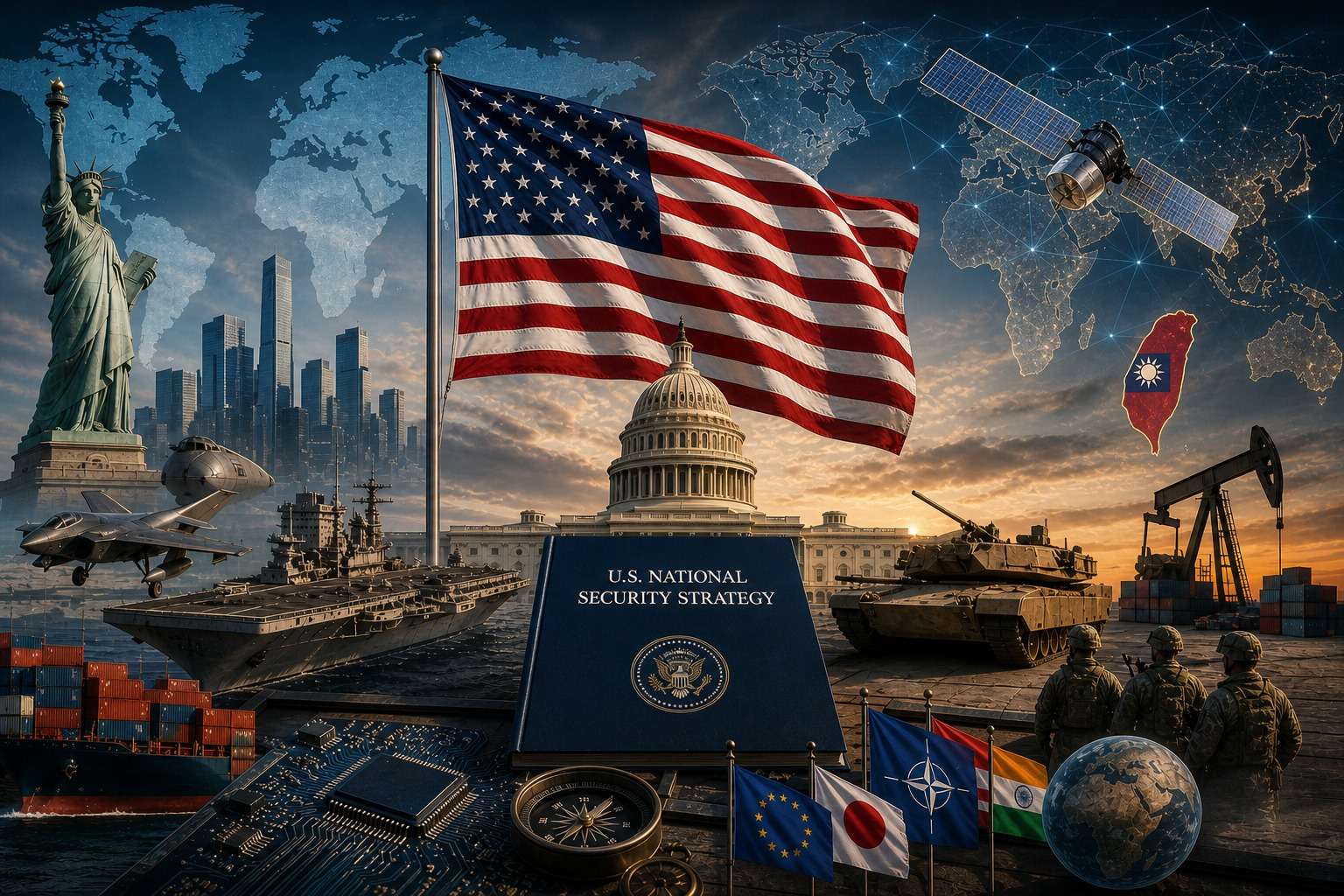
The U.S. National
Security Strategy document, issued by the White House on the fourth of December
2025, expressed a clear transition from “liberal hegemony” to a new American
model that blends realism and nationalism.
Accordingly, the
current document does not carry a clear difference from the documents of the
previous American administrations; it also differs from the document that was
launched by President Donald Trump during his first term, which sought to
present a more comprehensive picture of the challenges that face Washington and
the paths of dealing with them.
And in connection with
that, it becomes clear that the new National Security Strategy document has a
distinctly “Trumpian” character, and aims at crystallizing and framing the
approach of President “Trump” and his ideas, not to mention what it reflects of
a great and exaggerated estimation of the role of the president and what he has
done since his arrival to the Oval Office in his second term, as it considered
that he managed to achieve huge accomplishments in a short period.
And thus, it becomes
clear that the new document embodies the mentality of the businessman and the
logic of deals and the approach of “America First,” which means that it does
not frame “what should be,” but rather “what can be done” to achieve the clear
and direct American interests.
And in light of that,
this document carried several clear messages, which can be formulated as
follows:
1- Emphasizing the
approach of “America First”:
The U.S. National
Security Strategy clearly affirmed the necessity of preserving national
sovereignty and recognized that protecting borders and confronting immigration
are essential to national security.
This means the focus
is no longer on protecting the world or reforming it, but on protecting
American interests and enhancing the power of the United States across its
different dimensions (military, security, economic, technological, and
cultural).
And this matter is
closely connected to rejecting the draining of American resources into regions
or conflicts that do not clearly serve American interests or do not constitute
a direct threat to the security of the United States.
2- Military power as
the backbone of deterrence:
Despite the document
confirming the rejection of draining the American power on the international
arena, it stressed the importance and centrality of the United States
possessing the strongest army equipped technologically in the world, and that
by relying on reviving the defense industrial base for the sake of producing
the latest systems and ammunition, and the most efficient of them.
In addition, the
document confirmed the need to maintain Washington’s superiority in military
and dual-use technologies, with a special focus on fields where the United
States has comparative advantages, such as submarines, space, and nuclear
energy.
As developing military
power will help achieve the vision of President “Trump” for “peace through
power,” thereby deterring opponents whenever the need arises.
3- The economy in the
core of national security:
The new document links
economic power directly to national security, viewing the American economy as a
“pillar” of internal strength and global influence.
The document also
confirms that enhancing American industrial power is a top priority, alongside
balanced trade, securing access to supply chains and vital materials, and
preserving the dominance of the American financial sector on the international
stage.
In addition, the
document highlighted the importance of energy dominance, noting that it not
only fuels American economic growth but also makes the energy sector one of the
leading export sectors.
4- Leadership and
technological dominance:
The National Security
Strategy document reflects a clear recognition of the importance and centrality
of technology, and the necessity of placing competition and the technological
race at the top of the American administration’s priorities in the international
arena.
It confirmed the
desire that American technology and American standards – especially in the
fields of artificial intelligence, biotechnology, and quantum computing –
become the basis for pushing the world forward.
5- The right-wing
cultural identity:
The National Security
Strategy document included language that was not usual, to a large degree, in
previous strategies; it did not focus on the values of democracy and human
rights externally, but rather reflected a clear concern and fear of cultural threats
facing Americans at home.
And it stressed, in
this context, the necessity of confronting propaganda, influence operations,
and other forms of cultural sabotage.
And it emphasized the
importance of restoring and revitalizing “American spiritual and cultural
health,” noting that without it, long-term security is impossible.
6- Control over the
Western Hemisphere:
The strategy revived
the “Monroe Doctrine” according to a “Trumpian formula,” stipulating that,
after years of neglect, Washington will reassert the “Monroe Doctrine” to
restore its superiority in the Western Hemisphere and protect its homeland and
its access to vital strategic locations in this region.
The document also
indicated that Washington will prevent competitors outside the Western
Hemisphere from deploying forces, possessing threatening capabilities, or
controlling vital strategic assets.
And the document
concluded that failing to take this region seriously, which represents the
backyard of the United States, is a strategic mistake that Washington will pay
for years to come.
7- Tearing the
transatlantic ties:
The new document
represents a clear overturning of the pattern of relations that brought
together the United States and Europe for decades; despite confirming the
strategic and cultural importance of Europe for the United States, it stressed
limiting the role of Washington as a guarantor of the security of Europe,
calling the European countries to bear their security responsibilities by
themselves.
And the matter did not
stop at this limit, but rather went beyond it to direct criticisms related to
what the document described as a decline in Europe’s civilizational and
identity character on the one hand, and what it considered failures resulting
from submission to the institutions of the European Union on the other hand.
This is a scene that
rejects the European model and reproduces the discourse of right-wing parties
in Europe.
8- Continuation of the
importance of the region of the two oceans (Indian–Pacific):
The new document
carried a renewed confirmation of the importance of the region of the two
oceans (Indian–Pacific), which crystallized during the administration of
President “Barack Obama” through the concept of “Pivot to Asia” and the policy
of “Rebalance to Asia,” then President “Trump” during his first term changed
the term to the region of the two oceans (Indian–Pacific) to be more precise in
its geographical scope.
The document
highlighted the need to preserve this region as free and open and considered it
the most important arena of economic and geopolitical competition in the coming
century.
In addition, the
document reflects a continuation of the approach of relying on the network of
allies and partners in this region, in a way that prevents China’s dominance
and even helps encircle it without confrontation.
9- Emphasizing the
protection of Taiwan:
The National Security
Strategy document renewed the United States’ commitment to protecting Taiwan,
but did so on a different basis: its importance in semiconductor production and
its strategic geographic location.
Which means employing
Taiwan as a tool and ignoring its historical importance, which predates the
invention of semiconductors by a long time.
And in this context,
the document stipulated the need to deter any conflict over Taiwan by
maintaining military superiority.
10- Decline of the
importance of the Middle East:
The document confirmed
– clearly – the decline in the Middle East’s importance within the priorities
of American foreign policy, and that, in light of the region’s declining role
as the world’s most important energy source.
And despite that, the
document stressed that the United States will remain having core interests in
ensuring that the energy supplies in the Gulf do not fall in the hands of a
“clear enemy,” and that the Strait of Hormuz remains open, and ensuring freedom
of navigation in the Red Sea, not to mention that the region does not turn into
a haven for terrorism against Washington and the American interests.
In addition to that,
the document pointed out that Israel’s remaining safe remains among the core
American interests in the region, pointing to the importance of expanding the
path of the Abraham Accords to include more Arab and Islamic countries.
And paradoxically, the
document clarified that confronting threats will be “intellectually and
militarily,” meaning it did not exclude the use of American military force in
the region again.
11- Modest interest in
Africa:
The National Security
Strategy reflected a modest interest in Africa, similar to a large extent to
what appeared in previous strategies.
Meaning that it
follows the priorities of the previous administrations, as resolving conflicts
and preventing them, and increasing trade and investment with Africa, are not
new axes.
As the document
stipulated that Washington should seek to establish partnerships with selected
countries “to reduce the intensity of conflicts, enhance trade relations of
mutual benefit, and move from the model of foreign aid to the model of
investment and growth capable of harnessing the abundant natural resources and
the latent economic potentials in Africa.”
This appears largely
similar to what came in the Africa strategy that was launched in December 2018
during his first term, which revolves around (prosperity, security, and
stability).
The document also
considered that developing oil and gas and nuclear energy technologies will
generate profits for American companies and help Washington compete for
critical minerals and other resources.
Overall:
In sum, the National
Security Strategy document has clearly defined the philosophy of “Trump” and
the priorities of his administration during the coming three years, but it
carried many controversial points that do not only reflect the vision of the
current administration as much as they carry indications of the complexities
that the American arena is witnessing, which will push toward more polarization
and division.
The document also
reflects confirmation of the transformation the international system is
witnessing, in light of changes in the American role and Washington’s relations
with allies and adversaries.