
 By Dr. Tawfik Aclimandos / May 3, 2026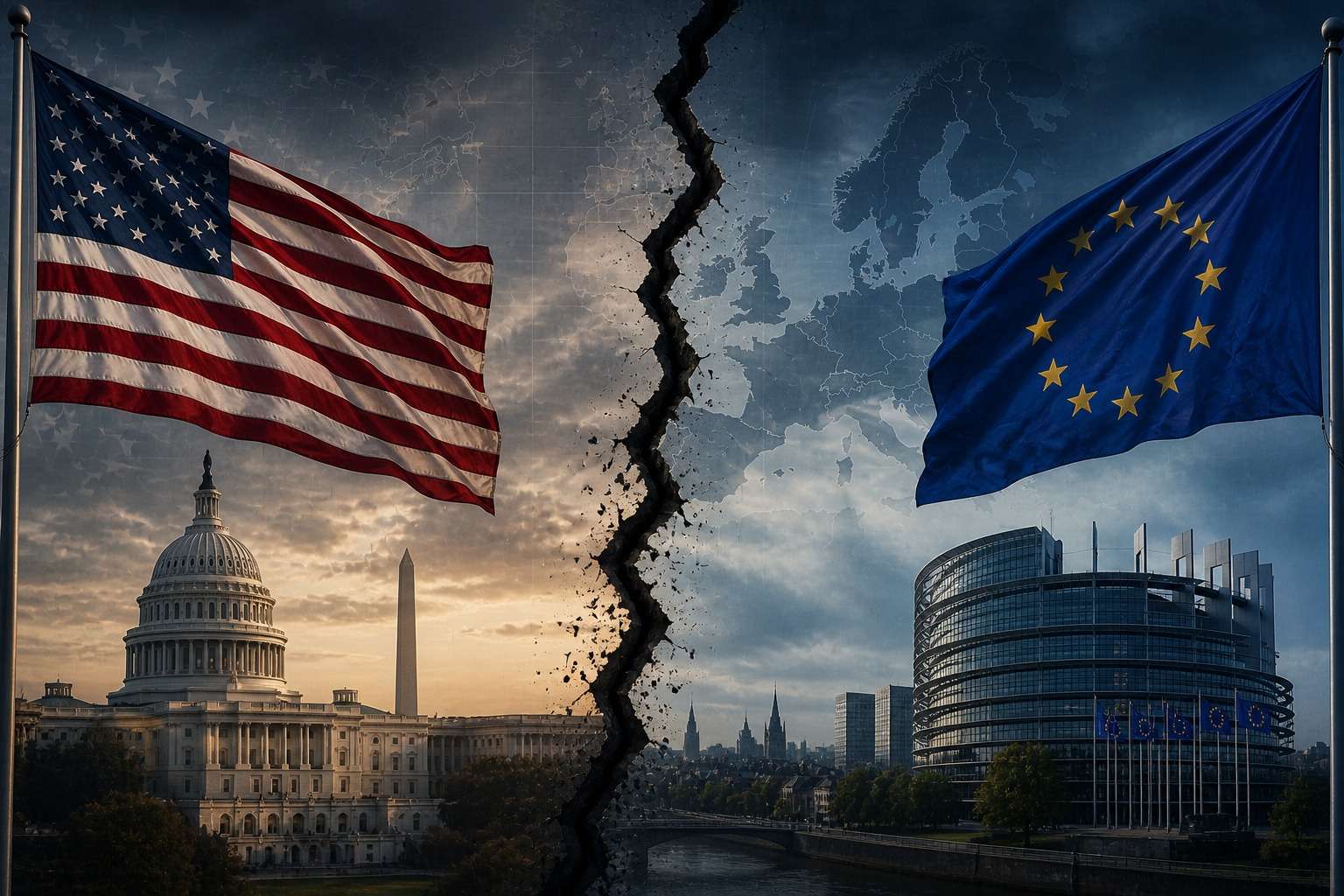
European official reactions to the U.S. National Security Strategy document varied between sharp rejection of what it contained and repeated affirmation that the United States remains Europe’s main ally and an important economic partner, and emphasis on the importance of the transatlantic relationship, in contrast to a limited welcome from a small number of countries, foremost among them Hungary.
The rejection responses focused, as stated by the German foreign minister and the President of the European Council, on three main points. The first is that the document included expressions not befitting a strategy document, as it reflects a narrow, hardline partisan view of the shared system of values.
The second is the rejection of the American diagnosis of the current European situation and of the pessimistic expectations for the continent’s future. The third is the assertion that Europe does not need external lessons on how to manage its internal affairs and rejects any American interference in this domain. Costa summarized the position, saying that the disagreement goes far beyond a mere difference in worldview.
In contrast, the harsh diagnosis of the European reality and the pessimistic prediction of the continent’s future generated clear satisfaction among rising right-wing forces, especially with the document’s pledge to support governments and forces that adopt an analysis close to that of the current U.S. administration regarding the decline of Europe’s civilizational identity and the loss of the foundations of its revival.
Away from official statements, which were few, varied, and delayed, the reactions of European foreign policy and strategic analysis communities help us understand European positions more deeply, especially the differences linked to geographical proximity or distance from Russia. The common denominator, aside from far-right currents, is a mixture of deep anger and intense concern.
Most analyses focused on treating the document as important and as a “turning point.” However, some experts downplayed its importance based on three considerations: first, that it appears as if it was written in response to an institutional custom only, that is, “to fill a box,” not to open an internal or international debate or to draw a clear policy, especially since much of its content is directed to the American internal sphere.
Second, it does not necessarily reflect the thinking of the decision-maker, that is, President Donald Trump, as much as it reflects the ideas of multiple currents within his administration, which explains its contradictions. Third, this administration is accustomed to saying one thing and doing another, as appears, for example, in its policies toward the Middle East.
But most experts preferred to take the document seriously because its content was consistent with statements by administration officials and with what leaked from their closed deliberations. Also, positions that contradict the document’s logic are far fewer than those that align with it, and often appear merely as attempts to gain time or as temporary submission to internal or external pressures. According to this trend, the document confirms that what Europe witnessed in 2025 was not merely a bargaining process to push it to increase defense spending or to take security issues more seriously, but rather reflects a comprehensive transformation in U.S. global strategy.
There is almost a consensus among these experts that the document portrays Europe as a burden and an unreliable ally. Some acknowledge that part of the American criticism of Europe has merit, but the problem is that the document directed its harsh criticism solely at Europe, while adopting a more cautious tone toward Washington’s adversaries.
First, the document’s philosophy holds that the era of the United States playing the role of the “global policeman” and guardian of the rules-based international order has ended. It also implicitly signals the end of the phase in which Washington pressed for the spread of democratic values and systems, and for their defense as a priority. Instead, the document calls for dedicating American effort to defending direct interests, not to exercising global hegemony. There are indications that the U.S. administration adopts the logic of “spheres of influence,” a logic defended by Russia and China, and it appears to include an implicit American acceptance that Ukraine, and perhaps its surroundings and Eastern Europe in general, fall within the Russian sphere of influence.
Second, the United States prioritizes searching for non-Chinese sources of critical minerals and rare earth materials. This consideration plays an important role in reshaping its priorities and pushes it toward rapprochement with Russia and the reestablishment of cooperation with it, in return for reducing Europe’s importance in American calculations.
Third, the new American approach toward Russia appears worrying in itself and even more so because it reveals a refusal to draw lessons from reality. The document does not clearly condemn the Russian regime or its internal and external behavior, while it frequently directs harsh criticism toward Europe. It also downplays the seriousness of the Russian threat, as Washington sees it as less dangerous than China, and then networks of migration, crime, and illicit trade coming from Central and Latin America toward the American internal sphere. In all cases, the document considers confronting the Russian threat primarily a European responsibility.
The language and objectives of the document suggest that the U.S. administration sees the possibility of “stabilizing” the situation in Eastern Europe, and considers this goal more realistic than confronting the Russian threat or thwarting Moscow’s plans. However, this “stabilization” may require major concessions at Europe’s expense, foremost among them Ukraine and the Baltic states, which may strengthen Russia and encourage it toward further aggression. It is noted that the United States announced last September a reduction in its military and security assistance to the Baltic states, while Europe awaits with concern Washington’s decisions on the global redistribution of its forces, decisions that are likely to reduce the American presence in Eastern Europe. The danger of this increases because Europe will not be militarily ready before 2030 at the earliest, meaning it may pass through its weakest phase between 2027 and 2030 without guaranteed American protection.
Fourth, the document devoted long paragraphs to Europe and the European Union. It acknowledges that Europe is an ally and that there is shared heritage between it and the United States, but at the same time says that this ally has become a burden that does not provide sufficient support, and that its current path has become a threat to shared values and to the foundations of the success of the Western experience, even reaching — according to the document — the level of threatening Europe’s “civilizational erasure” or distorting its identity. The paradox is that this discourse contradicts what the document itself declares: rejection of the approach of regime change and of reshaping and interference in the internal affairs of states, an approach it says characterized American behavior in past decades.
Behind this discourse stands, to a large extent, Vice President Vance, who sees that Western civilization was founded on pillars including Christianity and the sanctification of freedom. According to this view, the Christian character of Europe is declining due to Muslim migration carrying a different cultural system, and freedom is declining due to the abundance of laws regulating capitalism, restrictions on economic initiative, and legislation that hinders economic activity, in addition to the demonization of far-right discourse focused on nationalism, identity, and anti-immigration.
This discourse contains clear contradictions: it speaks of freedom but, at the same time, seeks to compel women and families to have children. Nevertheless, it is not without strength, because it expresses the views of important segments of European and American public opinion that the left and liberals have tried to silence. Its main weakness is that the U.S. administration does not show similar tolerance toward liberal and leftist discourses that value multiculturalism, but rather makes its battle against these discourses a clear axis of its vision in Europe and the United States.
The American discourse toward Europe can be summarized as follows: European states are allies, but not ones that can be relied upon. They must accept leaving the issue of stabilizing the situation on the continent to the Americans, and not object to their decisions. Washington will reduce its military presence in Europe, and will not deal with Europe as a single bloc, but will differentiate between states that adopt the liberal or leftist model and those that adopt a reading close to the current American reading. It will clearly work to empower political forces that adopt its approach.
Fifth, European states see that the document says, in brief, that Russia and China are not enemies so much as threats that can coexist and be dealt with, while the real enemy is whoever adopts a leftist or left-leaning liberal discourse, whether in Europe or the United States. These, in the document’s view, represent a threat because they move away from the values of Christianity and economic and political freedoms.
Sixth, frontline states with Russia see that the United States is essentially angry at an intellectual, political, and moral system that characterizes Western Europe, but in practice punishes Eastern European states “innocent” of these accusations, and exposes their security to great danger.
Seventh, a notable analysis by a prominent French expert stated that the current U.S. administration seeks to transform NATO from its current form into a form closer to the Warsaw Pact. The meaning is that Washington wants obedient allies who do not debate the major directions it sets, and at the same time wants allies ideologically similar to it: systems led by a strongman and following right-wing ideologies. This analysis may describe Washington’s “dreams,” but it remains an incomplete analogy; the United States, unlike the Soviet Union during the Warsaw Pact era, does not want to increase its military presence on the continent, but rather reduce it and place the greater burden on allies. Nevertheless, the importance of this analysis lies in revealing, unintentionally, the internal contradiction in the American document between its different orientations.
What is expected then? It appears that European leaders understood that the American position cannot be reduced to a mere desire to cut costs and maximize returns through continuous pressure. Rather, the matter reflects a strategic line aiming at a comprehensive change in U.S. foreign policy and priorities. They also understood that they did not have the luxury of waiting, even if the course of events might later force Washington to adjust its plan. In the end, they have become “alone” in facing risks, most of which come from the East, some from the West, such as Washington’s ambitions in Greenland, and some from the South. Here, the prophecy of General de Gaulle is realized: the United States will not risk its security for Europe’s security, and may one day withdraw.
The new situation imposes on Europe four or five priorities at a non-ideal timing: supporting and strengthening Ukraine; designing and producing the weapons of the future and investing rapidly and intensively in fields that were left to the United States; intensifying production of existing weapons to rearm European armies in a way that allows waging a long war; restructuring various supply networks; and involving the United Kingdom in the collective defense system.
European states’ positions on these priorities vary. Frontline states with Russia still see that purchasing American weapons and systems is necessary to maintain a degree of American protection, even if it has become less credible, but at the same time seek to intensify cooperation with Western European states. Other states have increased their military spending. Germany seeks to build its army into the strongest in Europe and, at the same time, become the main supplier of weapons to European armies. France seeks to maximize the benefits of possessing a “military-industrial and technological base” relatively independent of American components, and is considering revising its nuclear doctrine to no longer be limited to protecting French vital interests, or at least redefining these interests. There is strong, latent tension between Germany and France over major differences in several areas, including joint military projects. Spain remains the least concerned by the threat, while the Italian government has so far succeeded in reconciling its intellectual closeness to Trump and its good relations with him, with its European commitments and its constructive role within the Union, but fears that it may not be able to maintain this balance in the future and may be pushed to choose.
Regarding support for Ukraine, the Kiel Institute’s assessment, which closely tracks developments, indicates that Ukraine is facing a year of sharp decline in new aid allocations, the lowest level since the outbreak of the war in 2022. Europe allocated only about €4.2 billion in new military aid, a very small amount insufficient to compensate for the halt of U.S. support. At the same time, the gap within Europe widened; while France, Germany, and the United Kingdom significantly increased their allocations, they remained lower than those of the Nordic countries, while Italy and Spain contributed very limited amounts.
But Ukraine has developed its war industries and organized cooperation between the civilian and military sectors. The question remains whether the American document will push Europeans to accelerate and intensify their support, and how Europe will participate in the security guarantees to be provided to the stricken state.
The picture is incomplete without reference to the impact of the American shift on public opinion trends in Europe. There is a clear rise in the number of those who consider the United States an unfriendly state, and perhaps an enemy. At the same time, trends appear in several countries that see that this shift necessitates reaching an understanding with Russia, even at the expense of Ukraine, and seek to demonize the stricken state. The question is whether proponents of this trend will reach power. Nevertheless, support for Ukraine remains strong and enjoys majority backing in most major European countries.