
 By Dr. Maha Allam / May 3, 2026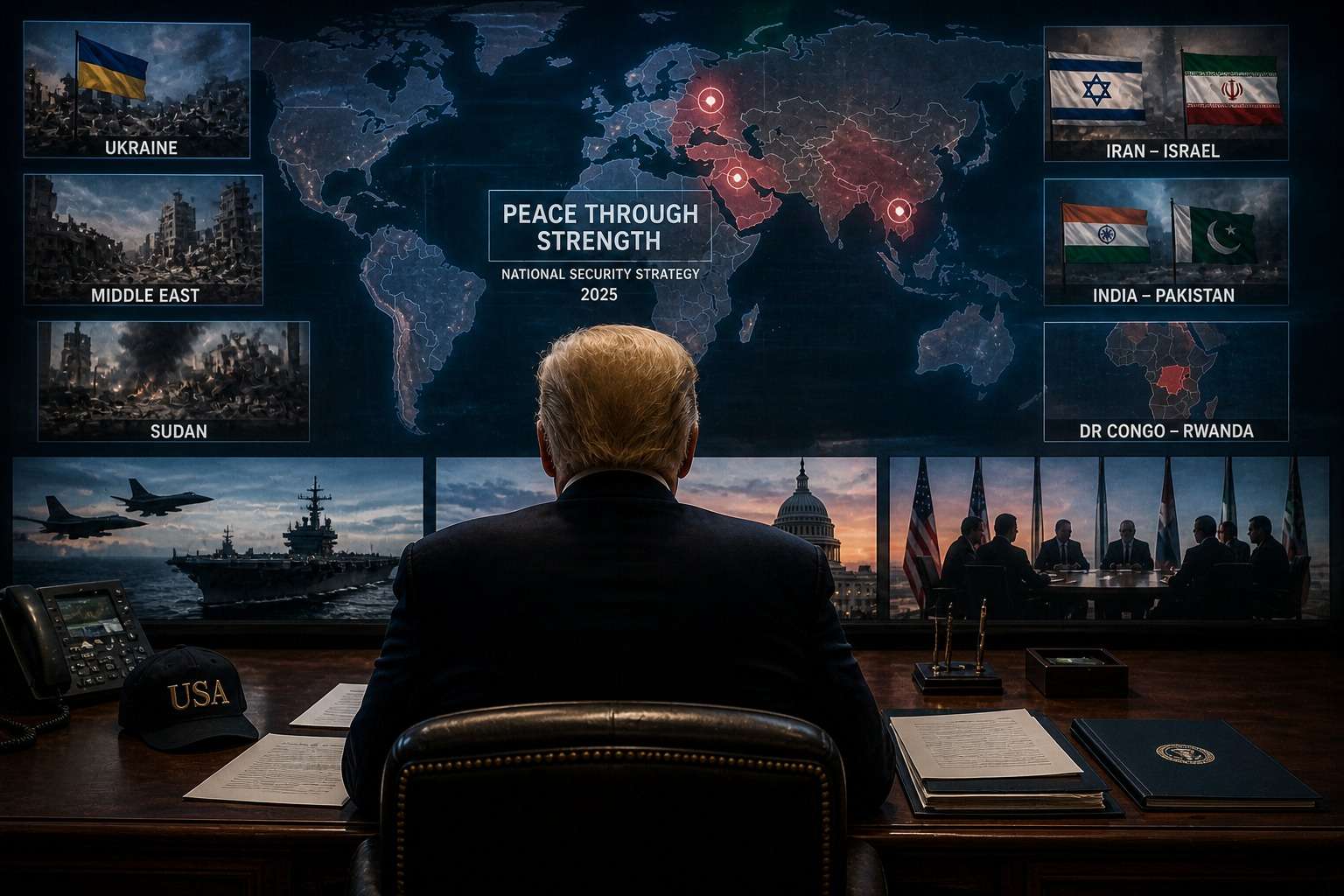
The National Security
Strategy document that was issued on 4 December 2025 provided an additional
affirmation of the calls of President “Donald Trump” related to the fact that
he deserves to be described as the “President of Peace” because he “settled” eight
conflicts within a few months of his return to the White House in his new term.
However, the reality
of conditions on the ground negates that, as the eight conflicts cited as
establishing Trump’s efforts to make peace carry differing narratives.
In two of them (Serbia
and Kosovo) and (Egypt and Ethiopia), there was no existing conflict to end.
As for the conflict
between Armenia and Azerbaijan, it had already ended before Trump took office.
As for three
victories, namely mediation in a ceasefire between India and Pakistan, and
Cambodia and Thailand, and Iran and Israel, it appears that Trump’s
intervention made a difference, but it did not end the root causes of the
conflicts in a manner that indicates the possibility of the situation erupting
again.
As for the two cases —
the conflict of the Democratic Republic of the Congo and Rwanda, and the
Israeli war against Gaza — the situation was not finally resolved, and the
fighting did not actually stop.
And despite Trump’s
claim of his ability to end the war in Ukraine within twenty-four hours of
assuming his position, peace has not been achieved in Ukraine yet, and there is
not even a clear path to achieving it.
And the Trump
administration has not — until now — taken any important step to deal with the
situation in Sudan, which is witnessing harsh humanitarian conditions and
massacres that require a decisive position and an urgent response.
In addition to that, Trump’s talk about annexing the island of Greenland, perhaps by military force if needed, represents a clear undermining of the value of peace in the international arena.
In this context, the
National Security Strategy document came to reflect the Trump administration’s
vision for peace, conflict, and stability, and also to reveal the expected
paths of movement for the administration over the coming three years.
This will undoubtedly carry clear implications for the prospects of global peace and can be crystallized as follows:
1- From ending
conflicts to managing them:
The document did not
clearly reveal that it targets ending conflicts and building peace, even as it
carries a formulation suggesting the possibility of managing conflicts in a way
that serves American interests.
This means attempting
to prevent conflicts from becoming a direct strategic threat to American
security and interests.
That is, peace,
according to this perspective, does not rest on settling conflicts, but on
temporary arrangements that prevent conflicts from escalating.
This results in redefining peace as a tool of stability that serves power, not as justice that ends conflicts.
2- Harming the role
of diplomacy and its performance:
The strategy carried a
clear praise of the non-traditional diplomacy that President Trump relied on in
his new term.
Which is the diplomacy
that was reflected on the ground in a variety of patterns, such as “social
media diplomacy,” “deal diplomacy,” “ambush diplomacy,” and “shock diplomacy.”
And accordingly, encouraging these patterns will contribute to a state of disturbance in the performance of traditional diplomacy, suggesting the collapse of some of the foundations and rules on which it is based, and even exposing the process of decision-making in foreign policy to whims and personal fluctuations.
3- Militarizing
peace as an alternative to building it:
The strategy focused
on combining military deterrence with building security alliances and
strengthening allies’ military power to ensure security and support stability.
But on the ground,
these movements may contribute to increased tension, a tendency toward more
militarization, and the erosion of peace paths.
In addition, the strategy’s principle of “peace through power” represents a deep contradiction with the concept of peace and the philosophy of its construction, as it is based on a mixture of coercion and deterrence.
4- Absence of a
unified concept of global peace:
Despite the fact that
the National Security Strategy is meant to address American interests rather
than frame global policy, the United States’ dominant position required greater
attention to peace and a clear definition of what it should be.
Thus, dealing with peace — according to the strategy — amounts to a fragmented formula that serves American goals and interests and may even be employed within the framework of containing adversaries.
5- Marginalizing
developmental peace:
Despite some indications that the strategy contained regarding democracy and human rights and governance and good governance, its focus on real investment in positive peace (development, justice, reconstruction… etc.) remains limited compared to the expansion of military bases and regional arms races and rigid security alliances that — according to the strategy — will ensure security and preserve stability.
6- Ignoring the
role of international institutionalism:
It appears that the
strategy deliberately ignored the role of international institutionalism and
international law in supporting and enhancing international peace and security.
This reflects
important messages that undermine the idea of peace stemming from a rules-based
international system and transform it into one led primarily by power.
As the strategy
stipulated that “the larger, richer, and stronger states are a fixed reality in
international relations.”
Which is a scene that may contribute to making peace subject — to a large extent — to balances of power rather than international legitimacy, in light of reliance on work outside UN frameworks and a focus on bilateral tracks.
7- Weakening the
role of Washington as a neutral mediator:
The National Security Strategy carries within it Washington’s acknowledgment of its retreat from the role of neutral mediator, based on a shift from reliance on values to reliance on interests, not to mention the contradictory foundations of the principle of “peace through power.”
In total:
In sum, the National
Security Strategy document for the year 2025 not only crystallizes the vision
of President Donald Trump and the goals of his administration, but it also
reflects a set of prominent transformations resulting from the return of the
Republican president to rule again in a second non-consecutive term, and it
carries clear implications and repercussions for the prospects of global peace.
As the document
indicates, we are moving toward a world in which conflicts are managed rather
than resolved, and in which peace is redefined to serve power, not justice.
That is, peace is an
extension of conflict by diplomatic means.
And accordingly, the
real danger lies not in the failure of peace paths, but in the transformation
of this pattern into a justified policy managed in the name of stability.
And what appears more
dangerous than that is the transformation of peace into a tool of competition
between major powers, where some peace paths will be intentionally obstructed,
while others linked to specific interests will be supported, and some peace
paths may be redesigned according to the satisfaction or dissatisfaction of the
participating actors.